Best in 7 days
![Strawflower, Silver Rose (Xerochrysum bracteata) - 25 Seeds]()
Pay in installments of $7.15 with
 ,
,
 and
and

Shipping Estimate
USA
- USA
- CAN
- USA
- CAN
Ships within 48 hours · Estimated delivery Jun 28 - Jul 3
 Promo Codes Available:
For Your Every Summer RSVP, with Code: SUMMER15
Description
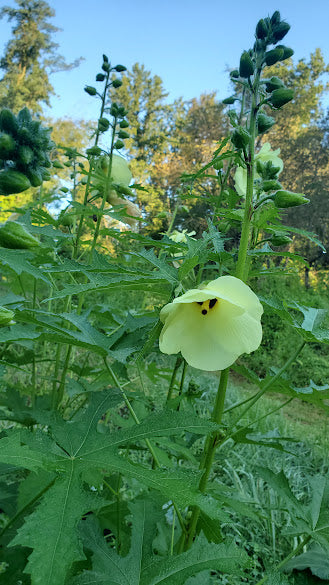
silk flower seeds Korean SilkflowerAbelmoschus manihot Origin: Korea (via North Carolina) Improvement status: Landrace Seeds per packet: ~35 Germination tested 10 2025: 60% Life cycle: Annual or tender perennial Abelmoschus manihot is a close relative of okra grown primarily for its nutritious and delicious greens. We got this seed from our friend Zach Elfers, who got from Yanna Fishman in Union City, North Carolina. This strain traces back to a Holocaust survivor named Agnes Adler,
Abelmoschus manihot
Origin: Korea (via North Carolina)
Improvement status: Landrace
Seeds per packet: ~35
Germination tested 10/2025: 60%
Life cycle: Annual or tender perennial
Abelmoschus manihot is a close relative of okra grown primarily for its nutritious and delicious greens. We got this seed from our friend Zach Elfers, who got from Yanna Fishman in Union City, North Carolina. This strain traces back to a Holocaust survivor named Agnes Adler, who received the seeds from a Korean patient at a mental hospital where she worked. He did not speak English well, but when Agnes asked his daughter to translate the name of this plant, she was told it is "Korean silk-flower." "Aibika" is the name used in New Guinea for this globally popular mallow, and it has somehow become the common name for this species in English, according to most sources. Abelmoschus manihot can produce an astounding 150 tons of leaves per acre, making it perhaps the most productive leaf crop on earth (an excellent, highly productive, enormous cabbage might yield 50 tons per acre).
Native to southeast Asia, it is now widely grown in tropical regions around the world, particularly from Africa to the Pacific Islands. It is cultivated primarily as a leaf vegetable, but the young flower buds are also eaten. The leaves are edible raw, or steamed, boiled, baked, stir-fried, etc. They are flavorful and mucilaginous, with thickening properties much like okra in soup, and are also highly nutritious, rich in vitamins and minerals. There's some talk about the dreid pods being made into flour. In Japan and Korea the roots of Abelmoschus manihot are used in a special traditional paper-making process. The stalks may also be used for fiber, but this is less common among cultivated varieties.
There's a great deal of diversity of forms in this species, with leaves ranging from round or heart-shaped, to maple-like, to spindly and star-shaped like cannabis. We are looking forward to trying out more diversity in future years. It makes attractive, large, yellowish flowers reminiscent of okra flowers and other hibiscus cousins. Even if not eaten, this plant has immense ornamental value. It grows very easily and readily from seed. It also flowers profusely and sets prolific amounts of seed. Recommended especially for lovers of okra.
GROWING TIPS: Very easy to grow. If grown as a vegetable crop, plants should be spaced at least 1.5 feet apart or more so they have plenty of room to grow large.
Shipping Notes
- Free Standard Shipping on $100+ Orders to the USA.
- Except Preorder products are shipped in 48 hours.
- Delivery to the USA:
- Standard Shipping : 3-10 business days
- If time is of the essence, please consider selecting expedited delivery for faster service.
Exchange/Return Notes
- We offer a 30-day return/exchange service after receiving.
- Final sale items are not eligible for returns or exchanges.
- To process your return/exchange, please contact us at [email protected]
- Please click here for more details>>> Return & Exchange Policy
Discover Niche Categories That Outsell silk flower seeds
Top-Converting Item to Boost Your Average Order
Best in 7 days
![Flower Stock Iron Pastel Mix 50 Non-GMO, Heirloom Seeds – David's Garden Seeds®]()
Best in 7 days
![Sunflowers For Mom]()
Best in 7 days
![Edible Petals Seed Kit]()
Best in 7 days
![Korean Silkflower – Experimental Farm Network Seed Store]()
4.2 ★★★★★
Based on 2005 reviews
Sort
Product Reviews
★★★★★ 1
Our dogs hurt their mouths chewing these bones
Color: Purple & Blue
I don't do a lot of reviews because I realize many are objective opinions. However, in this case I felt it was necessary to warn others. Our dogs are aggressive chewers. Their last rubber bones (not these) which we've purchased before, and recently purchased again, were destroyed quickly. Chunks of rubber came off the ends. Since those didn't hold up like they used to, I found these harder bones hoping they would last longer. They were able to gnaw into the hard plastic within a few minutes. This created sharp edges that cut their mouths. When I saw a bit of blood on the bones, I took them away from the dogs and threw them away. I wondered why they quit chewing on them after being so excited at first. Also, these are hard enough to damage a tooth.
WAS THIS REVIEW HELPFUL?YesReportShare
Reviewed in the United States on December 6, 2025
★★★★★ 2
Pups have shown zero interest in these toys….
Color: Purple & Blue
I would agree that these are indestructible being neither of my dogs have shown any interest in these at all. At this rate they should last forever…
WAS THIS REVIEW HELPFUL?YesReportShare
Reviewed in the United States on April 10, 2026
★★★★★ 4
Durable but losses interest
Color: Purple & Blue
My dog is an aggressive chewer. She was interested in this toy while it was new, but soon after lost interest. Good news is although it took a beating it did not break or splinter. If soppy toys are disposable in your house, give it a try.
WAS THIS REVIEW HELPFUL?YesReportShare
Reviewed in the United States on June 8, 2026
★★★★★ 5
Chew toy that will last!
Color: Blue&Red Fish
Great toy for a real chewer. It's been in the house for about 5 days and the toy is still intact and the squeaker is still squeaking.
WAS THIS REVIEW HELPFUL?YesReportShare
Reviewed in the United States on May 28, 2026
★★★★★ 5
My puppy love these.And he's an extra large american bully , so he put them through their paces
Color: Blue&Red Fish
These toys were an excellent choice. My puppy really enjoyed him and he's definitely an aggressive chewer.He's an extra large american bully. But a big baby, especially when it comes to his toy\nOf course he's tough on them But These definitely held up well. So if you have a.n aggressive Chewer these are an excellent choice
WAS THIS REVIEW HELPFUL?YesReportShare
Reviewed in the United States on April 11, 2026