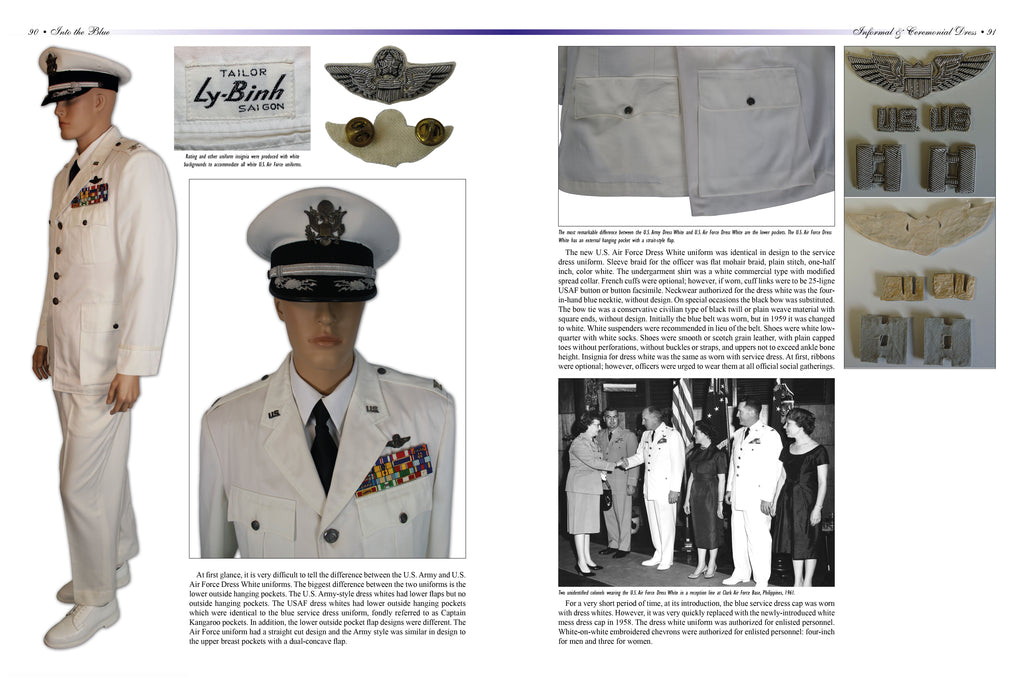
air force dress blues Into the Blue : Uniforms of the United States Air Force, 1947 to the Present: Volume Two: Distinctive Uniforms, Formal and Informal Uniforms
SKU: 3720564261
air force dress blues

air force dress blues Into the Blue : Uniforms of the United States Air Force, 1947 to the Present: Volume Two: Distinctive Uniforms, Formal and Informal Uniforms

Sale price$25.18 Regular price$27.98
Save 10%
Size: 4

Pay in installments of $7.00 with ShopPay, AfterPay and Klarna

Shipping Estimate
USA
  • USA
  • CAN

Ships within 48 hours · Estimated delivery Jul 2 - Jul 7

Promo Codes Available:

For Your Every Summer RSVP, with Code: SUMMER15

Description

air force dress blues Into the Blue : Uniforms of the United States Air Force, 1947 to the Present: Volume Two: Distinctive Uniforms, Formal and Informal UniformsThese are the uniforms not normally seen on an everyday basis by Air Force members, and include both formal and informal examples. With over 1,000 images, it is possible to trace the introduction of the various uniforms and the changes made over the years. Recognizing that uniforms come and go, this study provides the collector and historian with the uniform, and where possible, the story behind the uniform. Dave Schultz and Johnny Schlund provide a

These are the uniforms not normally seen on an everyday basis by Air Force members, and include both formal and informal examples. With over 1,000 images, it is possible to trace the introduction of the various uniforms and the changes made over the years. Recognizing that uniforms come and go, this study provides the collector and historian with the uniform, and where possible, the story behind the uniform. Dave Schultz and Johnny Schlund provide a combination of decades of research, and cover aspects of the formation of such distinctive career fields as Flight Nurses, WAF Utility Uniforms, Physical Training Uniforms, the USAF Honor Guard, and the largest of USAF career fields, the Security Forces.[AuthorName]By Lance P. Young, Photographs by Dave Shultz With Johnny Schlund[/AuthorName][AuthorBio]Lance Young has been collecting militaria since his father's friends gave him souvenirs that they had brought back from World War II. His love for the Air Force and law enforcement has manifested itself in his position as an instructor at Gunsite Training Academy, helping law enforcement, military, and civilians prepare to defend themselves and their families with a wide variety of weapons. In retirement he maintains his contacts and interests in the community. He resides with his wife Bonnie in Minden, Nevada.[/AuthorBio][NumIllustration]1,008 b/w and color photos[/NumIllustration][CoAuthor][/CoAuthor][SubTitle]Volume Two: Distinctive Uniforms, Formal and Informal Uniforms[/SubTitle][ColorPattern]1,008 b/w and color photos[/ColorPattern]
Shipping Notes
  • Free Standard Shipping on $100+ Orders to the USA.
  • Except Preorder products are shipped in 48 hours.
  • Delivery to the USA:
  1. Standard Shipping : 3-10 business days
  • If time is of the essence, please consider selecting expedited delivery for faster service.
Exchange/Return Notes
  • We offer a 30-day return/exchange service after receiving.
  • Final sale items are not eligible for returns or exchanges.
  • To process your return/exchange, please contact us at [email protected]
  • Please click here for more details>>> Return & Exchange Policy
SKU: 3720564261

Discover Niche Categories That Outsell air force dress blues

Top-Converting Item to Boost Your Average Order

4.8 ★★★★★
Based on 1248 reviews
Sort
Highest Rating
Newest First
Oldest First
Product Reviews
R
Verified Purchase
Robert and Jessica
West Palm Beach, US
★★★★★ 5
How to capture the import of an entire war by writing on its end
Format: Kindle
The authors seamlessly cover ed the macro and micro accounts of events and participants to capture the stunning and all important end of WWII. I was engaged and stimulated throughout my read of this book and highly recommend it for enthusiasts who are conversant with the war and want a better understanding of its close.
WAS THIS REVIEW HELPFUL?YesReportShare
Reviewed in the United States on August 27, 2025
M
Martin Southard
Cuba, US
★★★★★ 4
World War II - The Final Months
Format: Hardcover
The book takes you through the final months of World War II, focusing on eight key moments when the fighting finally came to an end. It’s not just a dry rundown of facts or battle maps — the authors do a great job of bringing the people involved to life, from famous leaders to everyday soldiers and civilians caught in the chaos. What I really liked was how the story moves around the globe, covering Europe, the Pacific, and beyond. It keeps the narrative fresh and exciting, giving a real sense of how the war unfolded on many fronts at once. Sometimes I had to pay close attention to keep up with all the locations and characters, but that only added to the feeling of being caught up in a fast-moving, gripping story rather than a history lesson. What stood out most was how it made me feel the human side of history—the fear, the relief, and the confusion as the war finally ended. It’s full of details, but it never felt boring or too technical.
WAS THIS REVIEW HELPFUL?YesReportShare
Reviewed in the United States on October 19, 2025
C
Verified Purchase
Christian Schlect
Louisville, US
★★★★★ 5
The Fix
Format: Hardcover
An insightful and interesting book on how our country's first legislators try to make sense of the new and fairly short U.S. Constitution, which, being drafted by humans, was bound to be imperfect. A lack of clarity on some point might be due to the changeable nature of words themselves or to confusion or obscurity of thought by the authors. And, who were the authors? The men in the room who came up with the product or the various state conventions that approved the final product? Professor Gienapp writes well and with a fine grasp of his subject. He uses concrete examples to illustrate his main points. For example, Congressional debates over the constitutionality of a proposed federal bank, the ratification of Jay's Treaty, and even whether the Bill of Rights was to be incorporated into or simply added to the original document. Most people think of U.S. constitutional history in terms of its drafting and ratification and/or its later judicial interpretation by the Supreme Court. Here, Professor Gienapp focuses on the initial work of interpretation by the first few sessions of Congress. This book is essential reading for those interested in the U.S. Constitution and the internal architecture of our government. I think those who spend countless hours viewing frenetic talking heads say this or that about the constitutionality of some issue or another (or the nomination of a justice to the High Court) should throw their television set out the window and, instead, settle into a corner chair and calmly read this and other such thoughtful books. This one should win prizes.
WAS THIS REVIEW HELPFUL?YesReportShare
Reviewed in the United States on October 14, 2018
G
Verified Purchase
Gadavis
Phoenix, US
★★★★★ 5
Excellent Book
Format: Hardcover
Stanford University History Professor Gienapp has done an outstanding job of researching and writing this historical analysis of the interpretation of the American Constitution by America's first Congress. Professor Gienapp analyzes data primarily from Congress's problems interpreting the removable of executive officers, chartering a national bank and approval of the 1794 Treaty with Great Britain negotiated by Chief Justice John Jay, the "Jay Treaty." Gienapp shows in clear writing how Congress used records of the debates at the Constitutional Convention and State Ratification Conventions to resolve these constitutional issues. I highly recommend this book to anyone concerned with the interpretation of the American Constitution.
WAS THIS REVIEW HELPFUL?YesReportShare
Reviewed in the United States on July 18, 2020
G
Verified Purchase
Gary Y. Larsen
Dallas, US
★★★★★ 5
An analysis of how we came to think about the Constitution the way we do
Format: Kindle
It provides a detailed analysis of the arguments used to talk about the Constitution in the ten years after it was ratified. These arguments shifted from treating it as a preliminary draft to be perfected through filling in the details of the operation of the government through experience, to a sacred document that had to be interpreted to determine its "true" meaning.
WAS THIS REVIEW HELPFUL?YesReportShare
Reviewed in the United States on December 18, 2018

recommand products